Showing posts with label New Testament. Show all posts

Thursday, December 21, 2017

➽ The Meaning of Bethesda (House of Lovingkindness) in John Chapter 5 ▧

(A painting of a stream. Click for source.)
The Meaning of Bethesda in John Chapter 5

(Click to Print This Document in a PDF Format)

John 5:2
"Now there is at Jerusalem by the sheep market a pool, which is called in the Hebrew tongue Bethesda, having five porches."

According to Strong's Exhaustive Concordance, Bethesda is made from two Hebrew words: bayith (#1004 in Strong's Hebrew section) and checed (#2617 in Strong's Hebrew section). 

Bayith means house.

Checed (kheh'-sed) is lovingkindness and many other things.

According to NAS Exhaustive Concordance, the Hebrew word checed (Strong’s #2617) includes lovingkindness, lovingkindnesses, unchanging love, devotion, favor, kindnesses, deeds of devotion, mercies, loyalty, and goodness in its definition. (Strong's Exhaustive Concordance includes pity as well.)


So, Bethesda Is a Word Meaning House of Lovingkindness. 


Friday, November 24, 2017

Abba God's Love for Us (in Greek and Hebrew Words) 🌍 Phileó and Koinónia and Natsar. /// The Deeper Meaning of Preserve in Psalm 31:23-24 and in Psalm 32:6-7.


(The prodigal son is embraced by his father. See Luke 15.
 Click for source.)
Some of the words Abba God uses in the New Testament to show His love for us include Phileó and Koinónia and Natsar.
⬛ Phileó in John 16:27

John 16:27 -- “[27] For the Father himself loveth you, because ye have loved me, and have believed that I came out from God.”

According to Thayer’s Greek Lexicon, the word loveth in English is phileó in Greek (Strong’s #5368). It means “1. … to love i.e. delight in, long for, … 2. to kiss…”

According to Strong’s Exhaustive Concordance, phileó means “... i.e. Have affection for (denoting personal attachment, as a matter of sentiment or feeling;...); specially, to kiss (as a mark of tenderness) -- kiss, love."

Thursday, November 16, 2017

Many People Have a Wrong View of God Being Harsh or Distant When He Is Gracious, Kind, and Compassionate

Many People Have a Wrong View of God Being Harsh or Distant When He Is Gracious, Kind, and Compassionate

There are many people (including Christians) who view God the Father as a very harsh, strict, or aloof God. But, these beliefs are not biblical because God is perfect Love (1 John 4:16). And, Abba God is gracious, longsuffering (patiently enduring), and gentle in dealing with His children, as a loving Father.
(This is not what Jesus actually looked like,
but this painting by a young girl 
(a child prodigy)  may capture
 an idea of the love that Jesus has for us.
Click for source.)

Psalm 86:5 says: "For thou, LORD, art good, and ready to forgive; and plenteous in mercy unto all them that call upon thee."


Exodus 34:6 says: "And the LORD passed by before him, and proclaimed, The LORD, The LORD God, merciful and gracious, longsuffering, and abundant in goodness and truth,"


Isaiah 41:10 says: "Fear thou not; for I am with thee: be not dismayed; for I am thy God: I will strengthen thee; yea, I will help thee; yea, I will uphold thee with the right hand of my righteousness."

Some Christians (like I used to struggle with) struggle with feeling that they have to perform for God's love and acceptance or perform to receive God's blessings in their lives. If they fail to do something they believe God wanted them to do, they might feel upset with themselves. If we do wrong, we need to genuinely repent, and then rest and receive God's forgiveness. Along with that, we need to forgive ourselves and seek to know God as our loving Abba Father, which is who He is.

1 John 1 is a very good chapter to read and meditate on. Here is a portion of it, below.


1 John 1, and Walking in the Light,
 and in Fellowship with God

Explaining Hebrews 12:1-2 (Explaining the Cloud of Witnesses, using the Bible)


Hebrews 12:1-2  
"[1] Wherefore seeing we also are compassed about with so great a cloud of witnesses, let us lay aside every weight, and the sin which doth so easily beset us, and let us run with patience the race that is set before us,
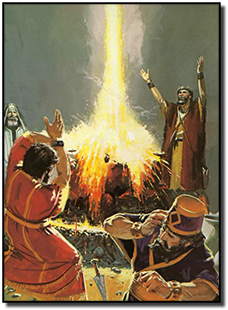
(Elijah calls fire down from heaven. Click for source.
[2] Looking unto Jesus the author and finisher of our faith; who for the joy that was set before him endured the cross, despising the shame, and is set down at the right hand of the throne of God." [End quote]

Some people are mistaken about their interpretation of Hebrews 12:1-2. They say that we Christians are literally surrounded by the spirits of people such as Moses and Elijah, but that is not what Hebrews 12 is teaching. This verse is speaking figuratively about how the believers who have gone up to Heaven have lived. They lived by faith and overcome the enemy through God's power. Their lives are an inspiration to us and a witness of how God's power operates through our faith.

Wednesday, November 15, 2017

The Persecution of Israel and the Jews in the Middle Ages, in the 1940s, and Today


The Persecution of Israel and the Jews in the Middle Ages, 
in the 1940s, and Today

(Vandalized synagogue. Click for source.)
We are seeing today an increase of hatred against Jews and Israel. The vitriol is astounding. Pro-Nazi and pro-Hitler accounts are popping up all over social media and the number of "anti-Semitic" incidents, or instances of persecution against Jewish people, are increasing each year. 

This article is divided up into these following parts:

1. Introduction

2. Hatred of the Jews During the Middle Ages

3. Biblical Answers for an Accusation Against Jews

4. "Replacement Theology," a False Doctrine

5. God Makes a Promise to Abraham and His Sons

6. Persecution of the Jews in Nazi Germany

7. Persecution of Jews Today

8. Conclusion


1. Introduction


I am writing as a Gentile follower of Jesus Christ. Jesus taught that we ought to love our neighbor as ourselves. There is no teaching of Jesus or of the Bible that agrees with the persecution of Jews. Persecuting the Jews is actually the very opposite of what God calls us to do. God wants us to love and care for others.
(Vandalized synagogue. Click for source.)


In Mark 12:31, Jesus said: "[31] And the second is like, namely this, Thou shalt love thy neighbour as thyself. There is none other commandment greater than these." Earlier, Jesus was saying to love God the Father with all the heart, soul, mind, and strength, teaching that this was the first commandment.  

Sunday, November 12, 2017

The Persecution of Jews Then and Now and the Rise of Hatred Against Israel

The Persecution of Jews Then and Now and the Rise of Hatred Against Israel


(Print this article here for free.)

(Vandalized Jewish tombstones. Click for source.)
I am writing to you as a Gentile and as a believer in Jesus Christ, who is my personal Savior and Lord. This article will focus on some issues today that have had their roots in ancient beliefs, which, sadly, are popular among many people today, even though these beliefs are unbiblical and hateful toward Jewish people.
__________


In social media websites and all around the world is a phenomenon which has been accelerating over the last few years. It is the hatred for Israel and for Jewish people (who are descendants of Jacob, a grandson of Abraham). 

This hatred of Jewish people goes back to ancient times. Haman, an official in the Persian Empire, sought to kill all the Jewish people in the empire. By using Queen Esther (a secret Jew) and Mordecai (her uncle), God delivered the Jewish people from destruction at the hands of wicked men in the Persian Empire. (You can read about it in the book of Esther, a book of the Bible.)


Persecution of Jews During the Middle Ages by Some Catholics

Monday, October 30, 2017

Matthew 5:5 Expounded — “Blessed are the meek: for they shall inherit the earth.”


Matthew 5:5 Expounded — “Blessed are the meek: for they shall inherit the earth.” [Print Document]


God the Father shows us in His Word the blessings of following Him and obeying Him. If we humbly depend on Him, we will be meek, and those who are meek shall inherit the earth. The Greek word for meek is praus. It includes meek and humble in its definition.


But, what does being meek look like? Let’s look at what a 19th century English dictionary has to say about this word. In the 1828 Webster’s dictionary, meek is, in part, defined as: “1. … gentle; not easily provoked or irritated; yielding; given to forbearance under injuries. ...” [and] “2. …  humble, in an evangelical sense; submissive to the divine will; not proud, self-sufficient or refractory [i.e. rebellious] ; not … apt to complain of divine dispensations. …” (See the footnote below).


Being Meek Means Not Being Easily Provoked

Simon Peter's Three (3) Denials of Christ and Peter's Three Boastful Statements in the Gospel Accounts

Peter's Three (3) Denials of Christ and Three Boastful Statements in the Gospel Accounts ________________________________ Wh...